Bitcoin Enters Transition Phase as Dormant Coins Begin Moving

Bitcoin on-chain data shows the market is more balanced than simply being in a “bull” or “bear” phase.
While Coin Days Destroyed (CDD) has shown some major spikes in July, other indicators, such as NUPL and MVRV, suggest that the market is cooling down rather than experiencing a major sell-off.
The data points to a healthy market reset, where long-term holders are becoming more active, but there are few signs of panic selling or large-scale profit-taking.
Dormant Bitcoin Is Starting to Move
Notably, CDD tracks the movement of older Bitcoin by measuring how long coins remained inactive before being spent. In July, CDD has been moving sharply up and down. It jumped to 32 million on July 2, dropped to 3 million two days later, rose again to 25 million on July 16, and continued fluctuating, most recently reaching around 9.8 million.
 Source: CryptoQuant
These spikes indicate that long-term holders are moving some of their Bitcoin. Historically, elevated CDD has coincided with increased movement of older coins, sometimes during periods of profit-taking or portfolio rebalancing.
However, current levels remain far below those seen during previous market peaks. For example, CDD exceeded 340 million in November 2025, suggesting that July’s activity is significant but not a sign of widespread selling.
Essentially, the data shows that older Bitcoin is moving, but not in a way that suggests a major market sell-off.
Bitcoin Movement Does Not Always Mean Selling
Meanwhile, a rise in CDD does not always mean investors are selling their Bitcoin. CryptoQuant analyst Rei Researcher noted that Exchange Inflow CDD on Binance remains low, suggesting that large amounts of older Bitcoin are not being transferred to exchanges for selling.
Instead, the movement could be the result of investors adjusting their holdings, moving coins between wallets, or preparing for future market moves. In short, CDD shows that older Bitcoin is becoming active, but it does not indicate strong signs of large-scale selling.
Profitability Has Declined, but the Market Has Not Collapsed
NUPL, which tracks the market’s overall unrealized profits, shows that Bitcoin investors are less profitable than they were earlier in the cycle.
Recent CryptoQuant data suggests that NUPL has moved back toward a neutral level. This means investor profits have declined, reducing the extreme optimism often seen near market peaks.
This suggests that the market is recovering after a period of speculation. Long-term holders are still sitting on healthy profits and are not showing the stress typically seen during major bear markets.
However, short-term holders are closer to breaking even, making them more likely to react to price changes and contribute to short-term volatility.
MVRV Shows the Market Is Fairly Valued
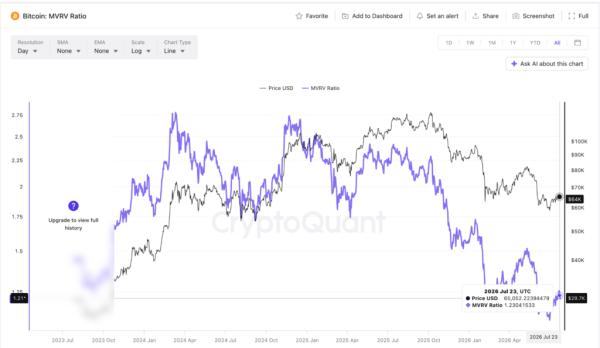
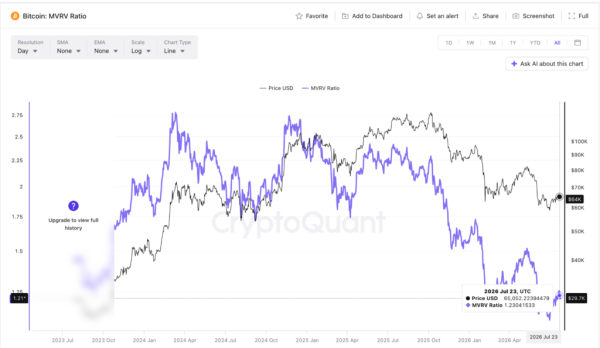
Meanwhile, Bitcoin’s MVRV ratio tells a similar story. It indicates that the market is currently neither significantly undervalued nor overvalued. With MVRV around 1.23, Bitcoin is above the levels typically seen during accumulation periods but still well below the extreme levels that often appear at market tops.
 Source: CryptoQuant
Long-term holders have seen their unrealized profits decline from previous highs, but they are not showing signs of large-scale selling.
In other words, MVRV suggests that Bitcoin’s valuation has cooled and returned to a more balanced level, even though prices remain high compared with previous cycles.
Long-Term Holders Still Confident
Despite increased Bitcoin movement, on-chain data shows that long-term investors remain confident.
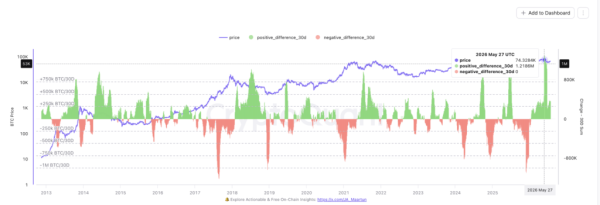
CryptoQuant analyst burakkesmeci reported that long-term holders bought 1.29 million $BTC, the largest accumulation since 2017. This occurred while Bitcoin was trading near its realized price.
In other words, the massive accumulation confirms investors view the 2026 $BTC decline as a buying opportunity rather than a reason to sell. Following this accumulation, Bitcoin’s price increased by about 15% from $57,500 to $66,000.
 Source: CryptoQuant
Meanwhile, CryptoQuant analyst Nino noted that more Bitcoin held for 6–12 months was moving into exchanges. Rather than viewing this as a sign of selling, the analyst suggested that it may simply reflect investors adjusting their portfolios as Bitcoin approaches key resistance levels.
Market in Transition
On its own, a spike in CDD could suggest that long-term holders are preparing to sell. However, the broader picture is more balanced.
Older Bitcoin is moving more frequently, but exchange inflows remain low. Investor profits have declined but have not collapsed, and market data suggests that Bitcoin has cooled from overheated levels. At the same time, long-term holders continue to show confidence by accumulating Bitcoin.
Essentially, Bitcoin’s on-chain data reveals that the market is transitioning. Old investors are becoming more active, but activity levels have not yet reached the point that will signal the end of a market cycle.
Related: Bitcoin Price Prediction: Is the 0.79 OTE the Buy Zone Before $BTC Retakes $67,000