Bitcoin flash crash erases $48 billion in 25 minutes

The Bitcoin (BTC) flash crash on June 25, 2026, wiped out $48 billion from its valuation in about 25 minutes.
The Bitcoin flash crash began at about 3:30 PM on Thursday, when the flagship coin had a market capitalization of around $1.225 trillion and an average 24-hour traded volume of approximately $44.14 billion, according to data from CoinMarketCap. As of 3:55 PM, BTC’s market cap had plunged to $1.177 trillion.
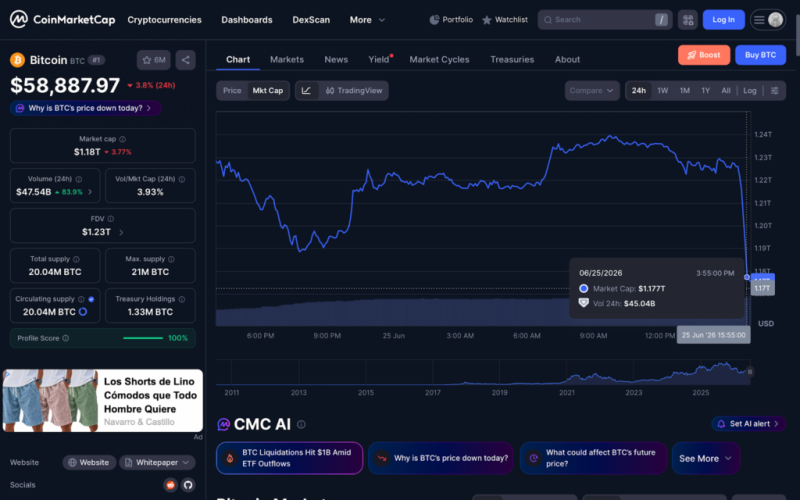
BTC price flash crash of June 25. Source: CoinMarketCap
As such, Bitcoin price dropped to the lowest point of 2026 of about $58,887 at the time of publication. The Bitcoin flash crash was fueled by low demand from United States institutional investors amid a long squeeze, a situation in which falling prices force long holders to sell, accelerating the decline.
Notably, the Coinbase Bitcoin Premium Index, a metric that measures the percentage price difference between BTC on Coinbase and the global average price, has remained predominantly negative over the past two months, based on data from CoinGlass. Essentially, negative values for this metric indicate weaker U.S. demand or selling pressure for Bitcoin.
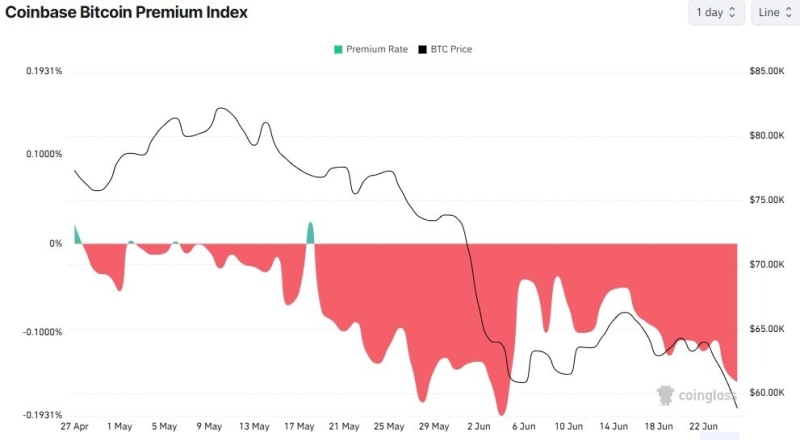
Coinbase Bitcoin premium index. Source: CoinGlass
The Bitcoin flash crash was further exacerbated by a significant liquidation of long positions, thereby fueling a long squeeze. Over the past 24 hours, more than $665 million was liquidated from BTC’s leveraged market, with over $543 million involving long traders, as per updates from CoinGlass.
What’s next after a Bitcoin flash crash?
With Bitcoin price heavily correlated with institutional capital flows in the United States, Peter Schiff, chief economist and global strategist at Europac, blamed the sell-off on Strategy Inc. (NASDAQ: MSTR).
“MSTR’s death spiral has pricked the Bitcoin bubble. MSTR fell another 8% this morning, down 84% from its high. STRC fell another 7%, bringing the total decline to 25% and raising the current yield to 15.3%, sending Bitcoin tumbling to $58,000, down 54% from its high,” Schiff noted.
With Bitcoin experiencing significant pressure from investors opting for AI stocks, as Finbold explained, Thursday’s crash could increase in the near future if the trend continues. However, if U.S. spot BTC exchange-traded funds (ETFs) resume accumulation, a potential rebound could follow.