What Bitcoin’s $16 billion options expiry means for investors
Synopsis
Ahead of the $16 billion Bitcoin options expiry on September 25, low price volatility reflects dealer hedging and positive gamma rather than low risk. As Deribit contracts reset, market structure shifts, making spot liquidity, macro trends, and fresh positioning crucial for Bitcoin’s next directional move.

Listen to this article in summarized format
Listen Loading…×× Subscribe to

Unlock AI Briefing and Premium Content
New Year Offer 24 Hours LeftSubscribe NowAlready a member? Sign In
What’s Included
- Exclusive Stories
- Daily ePaper Access
- Smart Market Tools
- Curated Investment Ideas
- Ad-lite Experience
Subscription

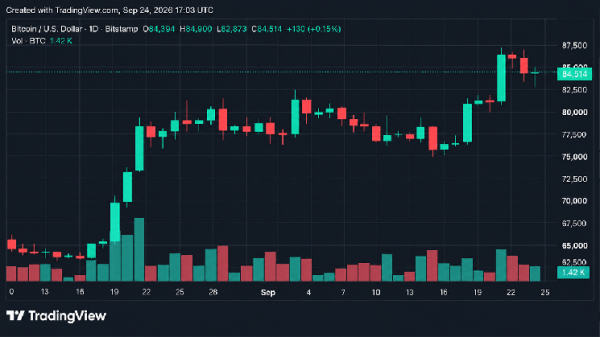
Bitcoin is trading around $86,000 ahead of one of the biggest events on this quarter’s crypto derivatives calendar. On September 25, nearly $16 billion worth of Bitcoin options are set to expire on Deribit. The size of the expiry matters because options do not simply represent bets on where Bitcoin will trade. They also influence how market makers hedge their exposure, and those hedging flows can affect short-term price behaviour.
Ahead of a large expiry, market makers continuously buy and sell Bitcoin or related instruments to remain hedged as prices move. Depending on their positioning, this activity can absorb some market movements and contribute to lower realised volatility.
That is one reason investors should be careful about interpreting Bitcoin’s recent stability as a sign that the market itself has become less volatile. Part of the calm may be connected to the structure of the derivatives market, and that structure changes materially after Friday’s expiry.
Crypto TrackerTOP COINS (₹) Tether96 (0.19%)BNB74,039 (-2.22%)Ethereum257,690 (-2.32%)Bitcoin8,070,422 (-2.44%)XRP145 (-6.83%)
The $16 Billion Options Setup
The positioning heading into September 25 is particularly interesting. Of the roughly $16 billion in Bitcoin options open interest expiring Friday, calls account for about $9.6 billion, compared with around $6.4 billion in puts. Significant call open interest is concentrated around the $90,000 and $100,000 strikes.
At first glance, that may look bullish. But options data needs to be interpreted carefully. A call option does not necessarily represent a simple directional bet that Bitcoin will rise. Options are also used in spreads, hedges, and market-making strategies.

Live Events
What the data does tell us is where a significant amount of positioning has accumulated. As Bitcoin approaches major strike prices, changes in option values can force market makers to adjust their hedges more aggressively. Once those contracts expire, much of that positioning disappears or rolls into later expiries. And that can change the way the market responds to the next large wave of buying or selling.
Also Read | How much of the current market movement is linked to the CLARITY Act vote?
Why ‘Max Pain’ Can Be Misleading
One of the most commonly discussed numbers around options expiry is max pain, the theoretical price at which the greatest value of outstanding options would expire worthless.
For the September expiry, estimates have placed Bitcoin’s max-pain level around 72,000 to 75,000, considerably below the current market price. It can be tempting to assume Bitcoin must therefore move towards that level before expiry. That would be an oversimplification.
Max pain is not a price target, support level, or prediction. Its relevance depends heavily on dealer positioning and the broader market structure. When Bitcoin is trading substantially away from max pain, particularly alongside strong positioning at other strikes, there is no mechanical rule requiring price to converge towards it.
Investors should therefore avoid treating $72,000 as an automatic floor or assuming $90,000 and $100,000 will necessarily become upside targets.
Gamma Matters More Than Max Pain
A more useful concept for understanding the current market is dealer gamma. In simple terms, gamma determines how quickly market makers need to change their hedges as Bitcoin moves. When dealers are positioned in positive gamma, their hedging activity can work against short-term price movements, selling into strength and buying into weakness. This can dampen volatility.
When the market moves into negative gamma, the opposite can happen. Hedging can reinforce the direction of the move, increasing volatility. Recent estimates place Bitcoin in a positive-gamma regime ahead of the September expiry. This helps explain why large options positioning can act as a volatility dampener rather than simply pinning Bitcoin to one particular price.
Friday therefore matters because a substantial portion of the options structure influencing today’s market will be reset.
What Should Indian Investors Watch?
For Indian investors, the most important takeaway is that low volatility should not automatically be confused with low risk. Bitcoin can spend days trading inside a narrow range and still be positioned for a larger move once derivatives positioning changes or a new macro catalyst arrives.
Investors should also resist reading options strikes as forecasts. Heavy call positioning at $90,000 and $100,000 tells us where traders have concentrated exposure, but it does not tell us that Bitcoin will necessarily reach those prices.
Similarly, the expiry itself does not provide a directional signal. Once positions expire or roll forward, Bitcoin could move higher or lower depending on spot demand, liquidity, macro conditions, and how the new options book develops.
This distinction is particularly important for investors using leverage. A period of unusually low volatility can encourage larger positions precisely when the underlying market structure is preparing to change.
September 25 should therefore be viewed as a reset, not a prediction. The roughly $16 billion Bitcoin expiry removes a significant layer of positioning that has influenced the market heading into the end of the quarter. What replaces it and whether genuine spot demand is strong enough to sustain the next move will matter more than any single max-pain number.
Bitcoin’s recent calm may continue beyond Friday. But after one of the quarter’s largest derivatives expiries, the market will have fewer reasons to assume that it must.
(This article is written by Prateek Gupta, Head of Business, Mudrex)
(Disclaimer: Recommendations, suggestions, views and opinions given by the experts are their own. These do not represent the views of The Economic Times)
Source