Bitcoin’s 5-year return is nearly zero, great narratives are fading and what’s left is the Fed
At the height of the bull market early last year, I saw social media posts saying the U.S. government could buy loads of bitcoin $BTC$61,425.11, sell it a few years later, and use the profit to write off its debt.
That belief came from past data. Bitcoin went from nothing to over $100,000 in 17 years, and the wealth-generating effect has been huge.
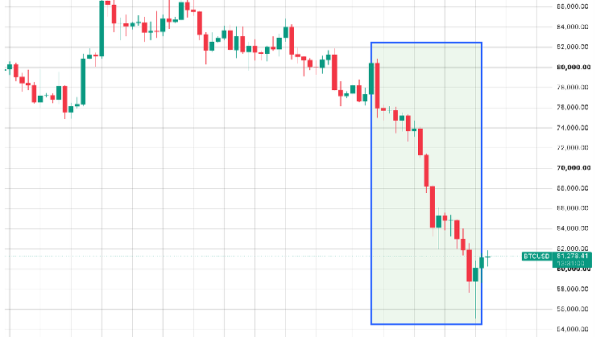
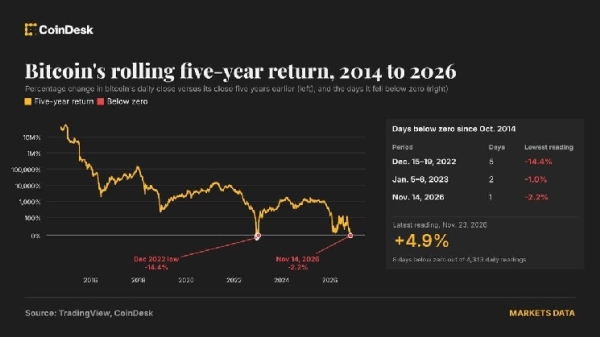
But guess what? As of now, the five-year return is next to nothing. A dollar put into bitcoin on Nov. 18, 2021 is worth about $1.10 today. Bitcoin traded around $61,500 as of writing, against $58,600 five years earlier. That is a less than a 10% gain in five years, before inflation.
The rolling five-year returns were actually negative a couple of days ago. This last happened in December 2022. After that, bitcoin rallied from about $16,000 to over $126,000, in line with the halving cycle.
The halving is a programmed code that slows the creation of new coins by half every four years. $BTC’s price has tended to rally and bottom around these events. Bull markets tend to end roughly 18 months after the event, paving the way for a year-long bearish trend, which is then followed by a new uptrend. That is the four-year cycle, and the peaks came in 2013, 2017, 2021 and October 2025.
We are at the start of that bullish phase again. Bitcoin peaked at a record high of over $126,000 on Oct. 6, 2025 and is now about 49% below that. There is a possibility that history repeats itself.
Bitcoin will almost certainly have another bull run, but that run could be less, well, bullish, and negative rolling five-year returns could become more common.
The data supports my view: each cycle has produced a smaller peak relative to the one before it. In other words, Bitcoin’s upside multiples have shrunk dramatically from cycle to cycle.
- The 2013 peak was about 42 times the 2011 peak.
- The 2017 peak was about 16 times the 2013 peak.
- The 2021 peak was about 3.5 times the 2017 peak.
- The 2025 peak was just 1.8 times the 2021 peak.
$BTC‘s parabola has weakened significantly. (CoinDesk/TradingView)
The cycle lows have been rising more slowly, too. Each bear market’s low has acted as a floor, and a line through those lows shows how fast the floor was rising. From the 2011 low to the 2015 low, it rose about 300% a year. From 2015 to the 2018 low, it rose about 110% a year. From 2018 to the 2022 low, it rose about 50% a year.
The second reason is that bitcoin pays no yield and has no business behind it, so it produces no cash. That matters because of what economists call the investment multiplier, which measures how much total output one dollar of spending or investment creates. When money is invested to build a power plant, or a tech firm, it pays workers and suppliers, who spend it again, and the economy ends up producing more than the original dollar.
When someone buys bitcoin, the money moves from one owner to another and nothing new gets built, so the direct effect on growth is close to zero. Apple, by contrast, reinvests its profits in new products, factories and jobs, and its shareholders own a claim on all of that. Gold pays nothing either, yet central banks hold plenty of it. The difference is a track record of centuries and far lower volatility.
This matters more than ever because governments are carrying so much fiscal debt. The U.S. federal government’s debt passed $40 trillion in August, and the IMF says global public debt is on course to reach 100% of global GDP by 2029, a level last seen after World War II. With debt that high, each dollar has to earn its keep. A government under that pressure is unlikely to put reserves into an asset that earns nothing and adds nothing to growth.

Know when your
coins move
Alerts, real-time prices, and market news — all in one app  Point your phone camera to install
 4.8 based on 40K reviews in the App Store and Google Play


The same logic explains why most companies with solid operating businesses haven’t embraced bitcoin to date. Most of the so-called digital asset treasury companies rode the 2024-25 bull run and had little business beyond holding the coin. Bloomberg described them as public firms “built to buy crypto and often doing little else”, and said many were small firms that rebranded overnight, among them a Japanese nail salon, a cannabis seller and a marketing agency. Strategy, the biggest of them, was recently dropped from MSCI’s index for lacking an operating business.
One positive area is the growth of Bitcoin-backed finance. It has expanded across retail, institutional, and traditional banking channels as borrowers use $BTC collateral to fund real-world expenses and operations without selling their holdings. However, with volatility still significantly elevated relative to traditional fiat currencies, and preferred collaterals, such as Treasury notes, a wide spread institutional adoption could be limited at best.
That leaves bitcoin dependent on risk appetite and the Fed
With the stories seemingly exhausted, bitcoin trades on risk-on and risk-off swings, meaning whether investors feel bold or defensive, and on dollar liquidity, the amount of dollars available in the financial system.
Arthur Hayes, chief investment officer of Maelstrom Fund, said today that Anthropic’s $1.5 trillion IPO could send Bitcoin much higher. If it massively pops, it’s game back on. $BTC is going to go up too,” Hayes said. “If it fails, every government will bail out the AI industry,” he added.
“$BTC wins either way.” Hayes predicted that all-time highs are coming.
Most analysts CoinDesk talked to recently also pointed to Fed rates as the main thing that matters for bitcoin.
So, after more than 17 years of meteoric price gains, the arrival of spot ETFs and a pro-crypto President, bitcoin’s fate still appears tied to what the Fed does.
If that is the case, bitcoin’s primary role may be evolving into a 24/7 VIX: a blockchain-based counterpart to Cboe’s VIX, Wall Street’s so-called fear index.
Note: The views expressed in this column are those of the author and do not necessarily reflect those of CoinDesk, Inc. or its owners and affiliates.
Related Assets Bitcoin$61,425.110.95%  Latest Crypto News
- 1 Eric Trump-backed American Bitcoin secures $150 million loan against its bitcoin9 minutes ago
- 2 Jensen Huang returns as Nvidia CEO as shares jump 27%57 minutes ago
- 3 Fidelity Investments, Strive, Etoro join OKX-ICE tokenized securities venue1 hour ago
- 4 Live updates: Bitcoin climbs above $63,000 as Nasdaq soars 6% on Huang return2 hours ago
- 5 Bitcoin’s losing streak is second-longest ever, and some observers see more downside2 hours ago
- 6 Ethereum wallets holding $72 billion ETH are under threat of a future quantum attack2 hours ago
- 7 Bitcoin rebounds from 2-year low as Wall Street futures recover3 hours ago
- 8 Japan to ramp up crypto tax audits after uncovering $24.5 million in hidden income3 hours ago
- 9 Live updates: Bitcoin climbs back above $61,000 as stocks rebound from AI rout3 hours ago
- 10 South Korea to expand cryptocurrency account freezes and curb illicit transfers abroad4 hours ago
 Thought Leadership
Regulated Cold Wallets with Instant Transaction Signing

Regulated Cold Wallets with Instant Transaction Signing
By CoinDesk Oct 22, 2026 Commissioned byHex Trust Read more More From Opinion 
The next Congress will write rules for AI and emerging tech. They should use the stuff first.

Will stablecoins survive once the banks catch up?

The election changes Washington. The work on crypto continues
More From Bitcoin 
Eric Trump-backed American Bitcoin secures $150 million loan against its bitcoin

Jensen Huang returns as Nvidia CEO as shares jump 27%