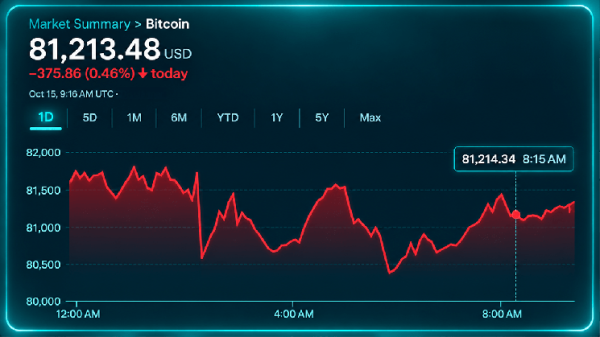
Government Bitcoin holdings fell 1,635 BTC in 2026 – 2 countries bucked the trend

Government Bitcoin [$BTC] holdings have declined in 2026, falling from 647,231 $BTC at the beginning of the year to 645,596 $BTC – a reduction of 1,635 $BTC. In this, Bhutan recorded the sharpest decline, with its tracked holdings dropping 91% from 5,984 $BTC to 518 $BTC.
Meanwhile, Kazakhstan and El Salvador are the only governments to have increased their holdings, with Kazakhstan holding an estimated 3,544 $BTC and El Salvador adding 287 $BTC.
Government’s Bitcoin holdings
Despite the overall decline, the U.S. remains the largest government Bitcoin holder with 328,372 $BTC, followed by China with 190,000 $BTC and the U.K. with 61,245 $BTC.

Know when your
coins move
Alerts, real-time prices, and market news — all in one app  4.8 based on 40K reviews in the App Store and Google Play

Whereas, Ukraine’s officials reportedly hold 46,351 $BTC, placing it fourth, while El Salvador ranks fifth with 7,803 $BTC. However, the decline in tracked holdings does not necessarily mean all the missing Bitcoin was sold, as some assets may have been transferred to wallets that are not tracked.
Just like a recent report from AMBCrypto, which highlighted that the U.S. government transferred 833.6 $BTC worth $71.6 million to Coinbase Prime on the 7th of October.
The Bitcoin imbalance
This comes as the U.S. institutional investors also appear to be facing stronger selling pressure. The Coinbase Premium Index, which remained deeply negative, indicated that Bitcoin is trading at a lower price on Coinbase than on Binance.
In layman’s language, such a drop signals weaker demand among U.S.-based investors compared with Binance participants, although they do not directly confirm institutional selling.
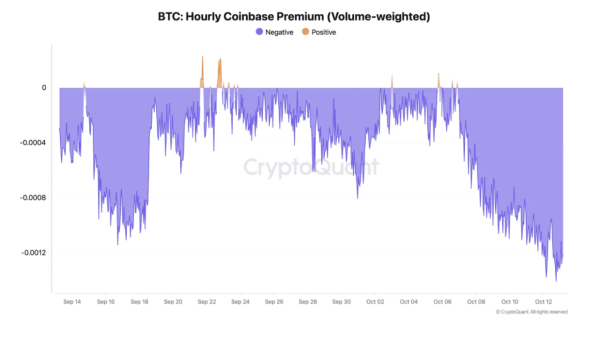 Source: CryptoQuant
All this comes amidst a concerning broader economic environment, which is also weighing on the bearish sentiment. For instance, rising bond yields make fixed-income investments more attractive, while persistent inflation and geopolitical conflicts add uncertainty.
Meanwhile, a stronger U.S. dollar can tighten financial conditions and reduce investors’ appetite for riskier assets such as Bitcoin. For Bitcoin, this creates a challenging near-term outlook.
Therefore, if institutional selling continues while liquidity remains tight, $BTC could struggle to recover or face further downside pressure.
On-chain metrics tell a different story
This comes as the price of Bitcoin was trading at $83,168.42 at press time after a modest drop. Meanwhile, the RSI indicator moving below the neutral level suggests that the bears have overtaken the bulls.
Moreover, the narrowing and parallel running Bollinger Bands suggest that the current momentum might continue to stay.
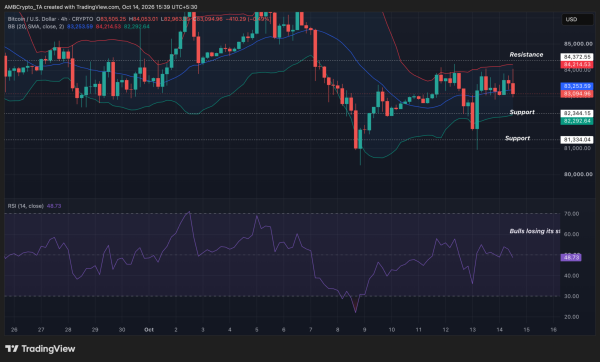 Source: Tarding View
On the other hand, the Bitcoin spot ETF has also seen $278.37 million in net outflows so far in October, following strong inflows of $2.65 billion in September.
But not everything is bleak, yet. As Bitcoin’s Net Unrealized Profit/Loss (NUPL) has recovered significantly in October 2026, rising to approximately 0.351.
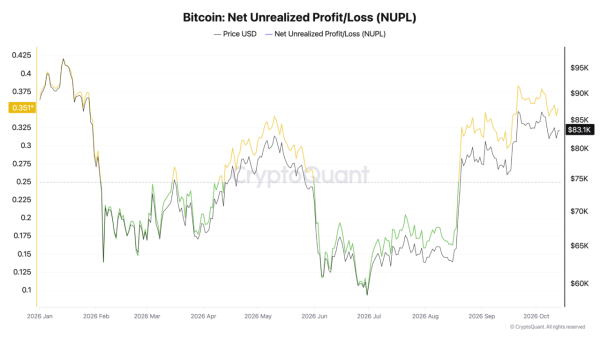 Source: CryptoQuant
This indicates that Bitcoin holders are sitting on substantial unrealized profits, suggesting improved market sentiment compared with the June–July period, when NUPL fell close to 0.10.
Final Summary
- While the Bhutan government has seen a drop in its Bitcoin holdings, Kazakhstan and El Salvador are the only governments to have increased their holdings.
- Bitcoin spot ETFs have seen $278.37 million in net outflows so far in October, following strong inflows of $2.65 billion in September.