Ledger CTO Warns Bitcoin Quantum Migration Could Take Years as SHRINCS Emerges

- Ledger CTO Charles Guillemet published a technical analysis on September 16, 2026, evaluating the SHRINCS post-quantum signature proposal.
- The SHRINCS draft specifies signature sizes ranging from 548 to 5,777 bytes, compared to the 64 to 72 bytes seen in current ECDSA and Schnorr schemes.
- The proposal combines stateful signatures using Flexible XMSS and WOTS+C with a stateless fallback mechanism backed by SHA-256.
Charles Guillemet, Chief Technology Officer at Ledger, warned that the Bitcoin quantum migration is not an immediate hardware threat, but rather a protracted technical coordination challenge that could take years. The statement was issued this Wednesday, September 16, following an evaluation of the SHRINCS improvement proposal.
Through a technical publication, Guillemet noted that the current custody framework relies on digital signatures that would be compromised by a cryptographically relevant quantum computer. A source reported that the specialist argued waiting for such hardware to emerge would represent an operational risk, given the extensive timeline required for research, testing, and network-wide deployment.
The evaluated framework, designated as SHRINCS, is a draft Bitcoin Improvement Proposal (BIP) authored by Conduition, Ethan Heilman, Mikhail Kudinov, Oleksandr Kurbatov, Jonas Nick, and remix7531.
The architecture relies exclusively on hash functions based on SHA-256, the network’s native algorithm. According to Guillemet’s analysis, this design avoids introducing additional hardness assumptions—such as lattice-based cryptography—and targets Category 1 security under the National Institute of Standards and Technology (NIST) standards.
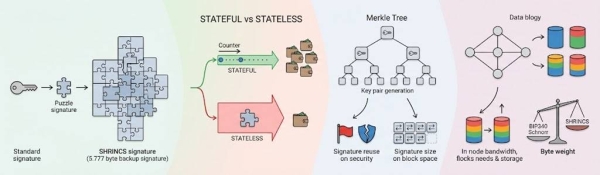
The draft’s technical specifications establish a 48-byte public key. In contrast to Bitcoin’s current space efficiency, stateful signatures range between 548 and 4,619 bytes, while the stateless fallback signature reaches 5,777 bytes.
Technical Challenges of SHRINCS and Wallet Management
Implementing this scheme introduces unprecedented operational requirements for custodial software and hardware. Based on technical data examined by Guillemet, the compact pathway uses one-time keys structured in a Merkle tree, requiring the signer to maintain a persistent counter that never rolls back.
An accidental backup restore or concurrent signing event could trigger cryptographic slot reuse, enabling third-party signature forgery. In the event of state desynchronization or data loss, the seed phrase can generate a 5,777-byte stateless signature, shifting the trade-off toward block space consumption rather than fund loss.
Furthermore, findings in the analysis suggest that hash-based key generation and stateless signature computation could take several minutes on contemporary secure hardware devices.
The model also fails to preserve unhardened derivation under BIP32 or the compact threshold signature schemes native to Schnorr. Nevertheless, per-byte verification is computationally lighter than BIP340 Schnorr, as it consists primarily of SHA-256 operations. The executive noted that larger transaction sizes will directly impact network bandwidth, storage overhead, and the ability of everyday users to operate full nodes.
Beyond algorithmic parameters, the transition presents major community governance dilemmas. According to the report, achieving social consensus on the fate of dormant coins whose public keys have never been exposed to the blockchain looms as a far more complex hurdle than selecting the mathematical standard itself.
Alongside this infrastructure debate, Ledger continues to navigate legal challenges following a class-action lawsuit filed on August 27, 2026, in the U.S. District Court for the Southern District of New York (Case 1:26-cv-07307-VM), where plaintiffs seek at least $500 million in damages tied to prior data breaches. Technical discussions surrounding the SHRINCS draft will continue across Bitcoin developer mailing lists, pending formal reviews of its security proofs.