Why did Trump-linked World Liberty crash over 60% in a week
World Liberty Financial’s (WLFI) cryptocurrency has plunged more than 60% in a week, extending a prolonged decline for the President Donald Trump family-backed project.
As of press time, WLFI was trading at $0.01724, down 60.29% over seven days. The sharpest losses came on November 28, when WLFI plunged more than 50% in 24 hours, briefly touching a record low of $0.0158.
The token has now lost more than 90% of its value since beginning public trading in September 2025.
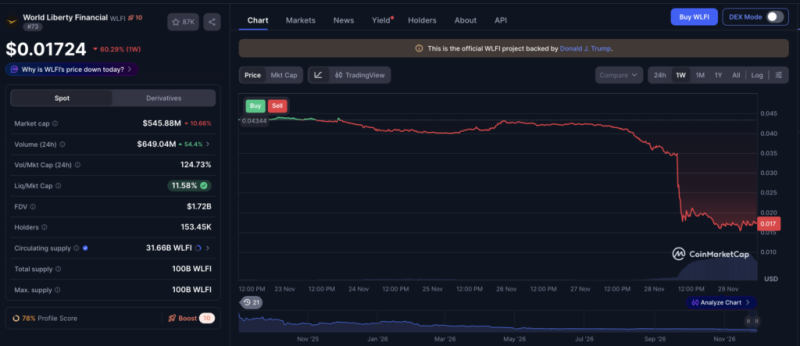
WLFI one-week price chart. Source: CoinMarketCap
Why WLFI is crashing
One development that attracted scrutiny was a substantial Ethereum (ETH) sale involving a wallet identified as World Liberty Financial’s Strategic Reserve.
The wallet reportedly sold approximately 12,121 ETH through the CoW Swap decentralised exchange aggregator for roughly $20.06 million in stablecoins.
World Liberty Financial's strategic reserve wallet sold 12,121 $ETH for ~$20.06M in stablecoins, locking in a ~$19.26M realized loss — the $ETH was bought last year at ~$3,244 and sold at ~$1,655.
I think: A 'strategic reserve' selling at half its cost basis is capitulation, not… pic.twitter.com/qpYqHeqESG— AuroraQAQ (@guangJ3) November 28, 2026
The transaction comprised $17.58 million in USDC and $2.48 million in USD1, World Liberty’s dollar-pegged stablecoin. The sale was executed at an average price of $1,655 per ETH, against an estimated acquisition cost of $3,244, resulting in a realised loss of approximately $19.26 million.
The transaction raised questions about the project’s financial position, particularly as it coincided with efforts to manage borrowing backed by WLFI tokens.
World Liberty’s borrowing arrangements on Dolomite, a decentralised lending protocol, also came under scrutiny. In April 2026, the project borrowed about $75 million in stablecoins against five billion WLFI tokens, allowing it to access liquidity without selling its governance tokens on the open market.
If you're shocked by what happened to WLFI today, you weren't paying attention.
In April, World Liberty pledged ~5B of its own tokens on Dolomite (co-founded by a WLF adviser) to borrow ~$75M in stablecoins. Depositors got stuck. They called it FUD.
Today the collateral…
— The Wolf Of All Streets (@scottmelker) November 28, 2026
Increased pressure on WLFI collateral
However, WLFI’s subsequent price decline increased pressure on the collateral. The borrowing position held approximately three billion WLFI against $42.2 million in stablecoin debt.
Based on the protocol’s collateral requirements, a decline below approximately $0.021 would have exposed the position to liquidation.
The project’s treasury subsequently sold Ethereum holdings to reduce its outstanding debt and strengthen its collateral position.
In a November 28 statement, World Liberty confirmed selling some of its treasury-owned ETH and mETH to repay debt, consolidate lending positions, and lower its liquidation price to $0.00631. It maintained that it had not sold WLFI tokens and that its USD1 reserves were not at risk.
However, the sharpest losses unfolded on Binance. Onchain data shows that heavy selling over 15 minutes after 11:30 p.m. ET on November 27 drove WLFI down nearly 40%, from $0.0345 to $0.0211, before further selling pushed it to approximately $0.0158.
The turmoil also affected USD1, which briefly fell to $0.94 against USDT on November 28 before recovering towards its $1 peg.
Dispute with Justin Sun
The crash also reignited World Liberty’s dispute with early investor Justin Sun, who accused the project of insider selling, circular lending, and investor fraud over his frozen WLFI holdings. Sun called on exchanges and regulators to intervene.
今天这起 WLFI 事件,不过是内部循环借贷套现、内部人违规出售、违法冻结投资者资产以及投资者欺诈的又一次上演。我呼吁各大交易所、监管机构、司法机关和法院,尽快对 WLFI 和 USD1…
— H.E. Justin Sun 👨🚀 🌞 (@justinsuntron) November 28, 2026
The allegations remain unproven amid an ongoing legal dispute. Sun sued World Liberty in April 2026 over the frozen tokens, prompting the company to countersue.
In November, he also sought sanctions against it over disclosures concerning its ownership structure and alleged UAE connections.
Featured image via Shutterstock